API integration (with samples)
Published
In this article: ► A simple example — connected in 3 minutes ► No single point of failure ► OFCA Do-not-call register filtering ► Smart Merge for Chinese and English name ordering
Today we look at the basics of API integration.
Once a business has built a mobile app, an online store or a CRM system, opportunities to use SMS come up constantly — member login verification, important alerts, and more. Getting an SMS reliably into a user’s hands comes down to one thing: how smoothly your existing system can trigger the send.

Think of the API as a bridge between your systems and our SMS gateway — and we do the work of making that bridge easy to cross. Using JSON and Smart Merge *(explained below), together with OFCA Do-not-call register filtering, your IT team can complete the setup in a handful of steps. For what the law requires of promotional senders, see Hong Kong promotional messaging compliance checklist — what the UEMO requires of senders.
Our platform has been through full load testing and can process up to 1,000,000 SMS concurrently within minutes. For OTP messages — particularly for financial institutions — we complete the send within 5–10 seconds. The system was designed around a robust queuing mechanism able to absorb large bursts of requests at speed, and a no-single-point-of-failure architecture so that a busy node or a hardware fault does not stop messages going out on time. For common problems when implementing OTP, see Six pitfalls in OTP SMS implementation — from code design to SMS bombing defence.
On top of that, we provide dashboard access so you can review send records and track progress and status at any time. For what each status code means, see SMS DLR status codes explained — what SMD, DELIVRD, UNDELIV and REJECTD actually mean.
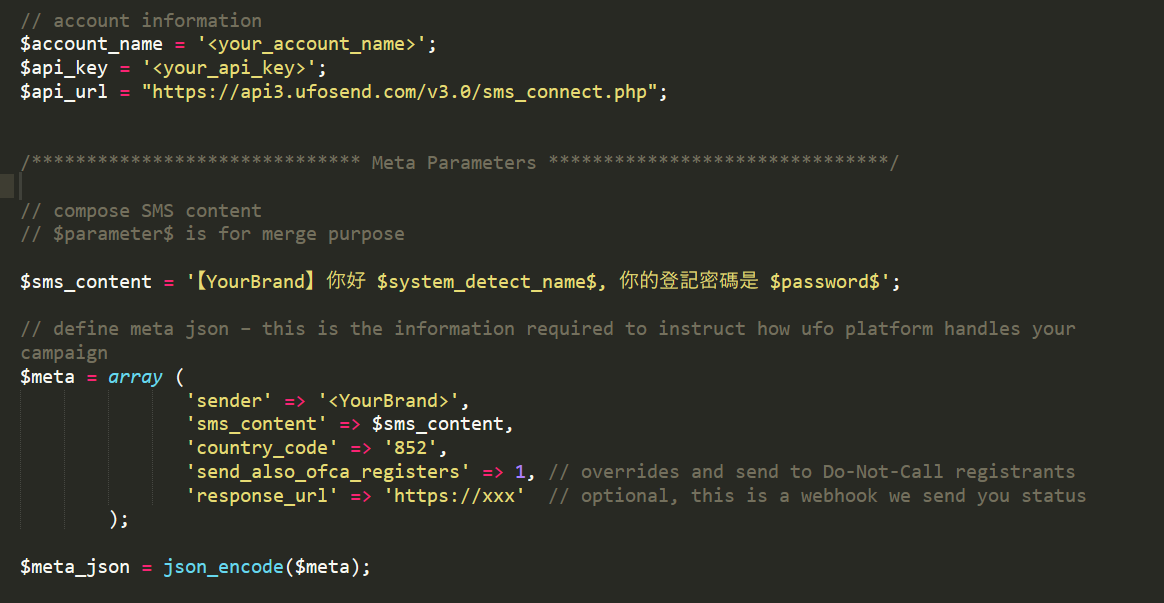
A simple integration example:
* Smart Merge
We use the $param$ format, where ‘param’ is a parameter you define.
$system_detect_name$ is a name-detection feature: the system checks whether the parameter contains double-byte characters and orders the display accordingly.
For example:
- You supply the full name “陳大文” => the system displays “陳大文”
- You supply last name “陳” and first name “大文” => the system displays “陳大文”
- You supply last name “Chan” and first name “Jackson” => the system displays “Jackson Chan”
How do businesses actually use the API?
Clients sending SMS through our API every day come from every sector — retail, e-commerce platforms, systems integrators, mobile app developers, clinics, banks, securities firms, laundries, food delivery, and more.
- Retail tends to use SMS for promotions: birthday offers, seasonal picks and the like. Customers generally respond well to this kind of SMS, and can register on their phone and redeem the offer immediately.
- E-commerce platforms and CRM teams mostly use SMS to reach customers with delivery notices and member-only offers. App developers use it for phone number verification, password resets, and even system alerts.
- Banks and securities firms lean on SMS for two-factor authentication, both at login and for transaction notifications.
- Clinics and event organisers commonly use SMS to remind customers of appointment times and locations.
Plenty of other businesses use SMS for day-to-day operational announcements. A recent common example: airlines notifying passengers of schedule changes and tightened entry requirements during COVID-19. To send a first message step by step, see Taiwan SMS API quickstart — from sign-up to your first SMS to +886 (cURL, Node.js, Python, PHP).