Sending SMS to mainland China
Published
In this article: ► SMS format ► What to know about SMS keywords ► The carrier’s role
You will be familiar with mobile apps using SMS verification codes to confirm a user’s identity. But have you considered what needs special attention when the user has a mainland China (+86) number? For how verification codes work, see What is an SMS code? How one-time passcodes (OTP) work.
Imagine that even words like 「笨蛋」 or 「白姐姐」 sometimes fail approval. Do you know what vocabulary should be avoided inside an SMS?
Our business clients include a number of securities trading firms, many of whose users register with mainland China (+86) numbers, and every completed transaction requires an SMS confirmation. So what is the trick to producing content that passes?
First, the conditions to watch when sending SMS to mainland China:
-
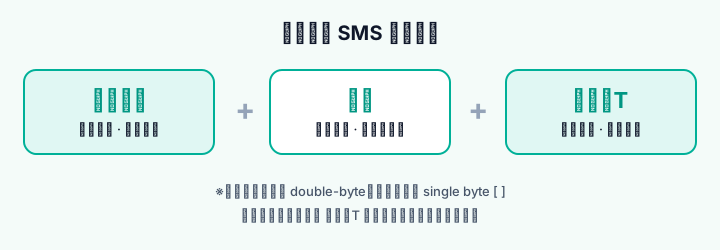
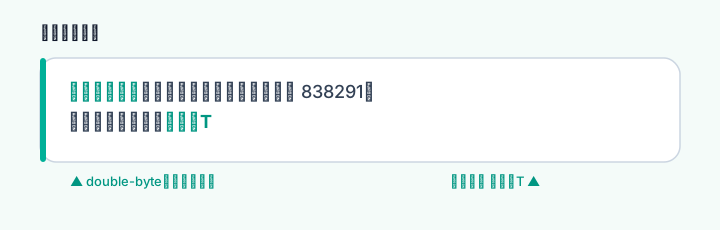
The 【signature】 must appear at the start of every SMS, and must use double-byte 【】 — single-byte [ ] will not do
-
The 【signature】 is the brand name, and a Chinese name is more widely accepted than an English one
-
Every SMS must end with the fixed string 退订回T
-
In short, when submitting content to mainland Chinese carriers for approval, the SMS format should read 【signature】 + content + 退订回T
-
How long mainland carriers take to approve content
-
To pass approval, the content has to avoid specific keywords — and the rules are stricter for securities trading
-
A reliable SMS provider can manage keywords and SMS format for you
-
A good network connection into mainland China
-
A direct channel for receiving the latest operational policies and upgrades from mainland carriers
-
The provider’s ability to track SMS send records, progress and status
Business clients often struggle to get SMS through to mainland users. Sometimes the content fails carrier approval, sometimes the carrier has unilaterally changed its policy, and more often than not the SMS format requirement was overlooked. To take a more extreme case, content approved today does not guarantee clear passage tomorrow — so the provider’s ability to track, investigate and resolve technical problems is critical.
Beyond that, an experienced provider can anticipate revisions in mainland carrier policy and prepare in advance, reducing the business lost when SMS service is disrupted. For the basics of sending international SMS, see Do you want to reach customers worldwide by SMS?.
You might assume keywords like “stock” or “securities” would sail through. The reality is not that simple.
When a client’s business requires sending SMS into mainland China, we provide layout and keyword guidance so they can draft the content themselves. Once we receive it we review it, making sure it matches the precise requirements of mainland carriers — usually within 0.5 to 1 working day — and suggest keyword or content revisions where appropriate.
Once formal carrier approval is obtained, we arrange test sends and track progress and status to make sure the ongoing service works well. SMS sent without formal carrier approval may arrive late or disappear entirely. Format matters just as much: an SMS without a double-byte 【signature】 at the start and 退订回T at the end is never going to reach the user. To test delivery yourself, see How Hong Kong Businesses Compare International SMS API Deliverability — Four Tests You Can Run Yourself.
There are two categories of SMS:
Promotional — member promotions, bulk marketing and the like
Functional (OTP, one-time password) — mobile verification, password delivery, system notifications
The signature and content rules apply to both categories, which is to say every SMS. The 退订回T portion, however, is not needed for OTP messages, because they are not promotional and require no unsubscribe handling — for OTP, approved content is enough.