Bulk Email Isn’t an IP Swap Game: Sender Reputation, List Hygiene, and Warm-Up Explained
Published
On this page
- Myth 1: “We need extra IPs — or we should keep changing them”
- Myth 2: “If we whitelist the ESP’s IP, marketing mail will get through”
- What mailbox providers actually weigh
- List hygiene often matters more than IP choice
- Warm-up: when you need it — and when you do not
- Dedicated IP: when it is worth it
- Spam filters are real — escaping them by swapping IPs is the myth
- How a careful broadcast workflow protects brand and pool
- Practical checklist before the next big send
- The honest conclusion
Key takeaways (Key facts)
- Deliverability is driven by sender reputation, not by collecting spare IP addresses. Mailbox providers score both the sending IP and the From-domain; with SPF, DKIM and DMARC aligned, domain reputation usually weighs more over time.
- Frequently swapping IPs often hurts inbox placement — it resets hard-won reputation and can look like evasion.
- List hygiene (hard bounces, spam traps, purchased lists, low engagement) typically matters more than which IP you used today.
- Warm-up is required for new dedicated IPs and new sending domains. High-reputation shared pools are usually already warm; a new From domain still needs its own ramp.
- Monitoring (Google Postmaster Tools, Microsoft SNDS, blocklist health, campaign metrics) plus disciplined broadcast handling — not IP rotation — is how serious senders stay in the inbox.
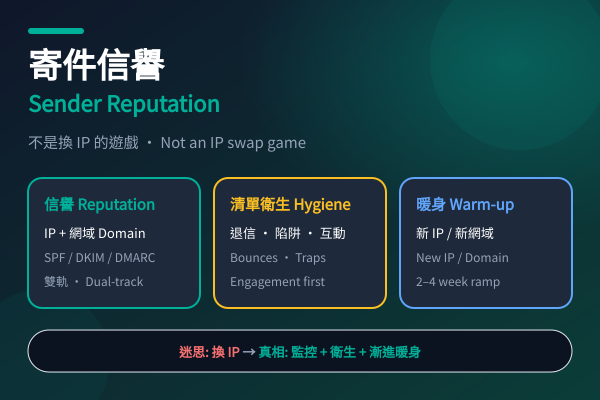
When a campaign lands in spam, the instinct is often to ask for another IP. “Maybe this one is burned.” “Can we rotate?” That framing treats inbox placement like a game of musical chairs. It is not.
Mailbox providers — Gmail, Microsoft, Yahoo and the rest — decide placement from a composite of signals. The sending IP is one of them. The From-domain, authentication alignment, complaint rates, bounce patterns, engagement and list provenance are others. Changing the IP while leaving a dirty list or a cold domain in place rarely fixes the problem, and it often makes the next campaign harder.
This article walks through the myths marketers still hear about bulk email, what actually moves deliverability, and how a prudent operations workflow — batching, monitoring and status handling — protects both the brand and the shared infrastructure everyone else depends on.
Myth 1: “We need extra IPs — or we should keep changing them”
Extra IPs sound like insurance. In practice, reputation is earned per identity, and mailbox providers notice when traffic jumps from address to address.
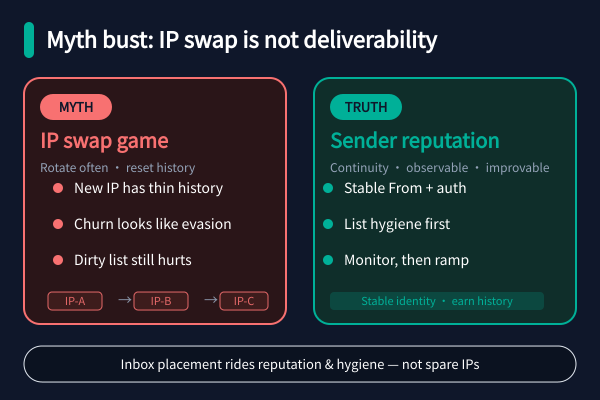
The diagram puts the two paths side by side. On the left, the IP-swap game: a new address has thin positive history, jumpy traffic can look like evasion, and a dirty list still hurts after you move. On the right, sender reputation: a stable authenticated From-domain, list hygiene first, and volume growth only after monitoring. Inbox placement rides continuity you can observe and improve — not a stash of spare IPs.
A new dedicated IP starts with little or no positive history. Every sudden volume spike, every hard bounce, every complaint is scored against a thin record. Switch IPs repeatedly and you keep resetting that history. From the provider’s side, unexplained IP churn can also resemble the behaviour of senders who are trying to outrun a block — even when the intent is innocent.
What you want instead is continuity: authenticated mail from a stable From-domain, sent through infrastructure whose reputation you can observe and improve. Continuity is why shared pools that are already well regarded can outperform a brand-new dedicated IP that is pushed too hard, too soon.
At UFOSend, traffic on our shared sending pool rides infrastructure that already carries a strong track record — with a reputation score around 99.5 on the signals we monitor. That does not mean every campaign is automatically inbox-safe. It means the pool’s baseline is healthy, and your job (and ours) is not to “escape” it with a different IP, but to keep list quality, authentication and send behaviour consistent with that baseline.
Myth 2: “If we whitelist the ESP’s IP, marketing mail will get through”
Allowlisting has a place in some B2B transactional setups — for example, when a corporate mail team explicitly trusts a known system for password resets or invoices. It is not the standard fix for marketing EDM.
Consumer and free-mail providers do not generally let brands “whitelist their way” past spam filters for promotional volume. Even inside enterprises, marketing streams are often evaluated separately from transactional ones. Asking recipients to whitelist an ESP IP might help a handful of internal test inboxes; it will not repair systemic reputation or engagement problems at scale.
Treat allowlisting as a narrow operational exception, not a deliverability strategy.
What mailbox providers actually weigh
Think of sender reputation as two related ledgers that move together:
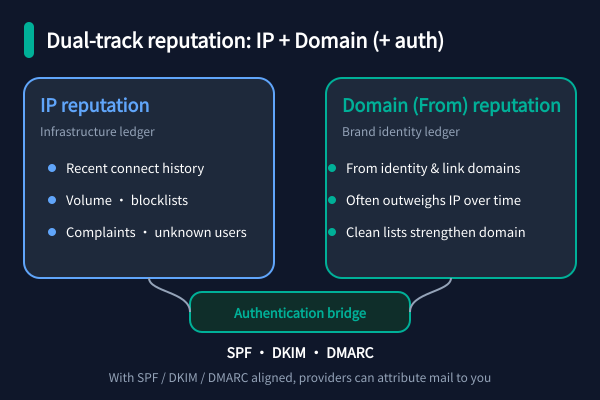
On the left, IP reputation is the infrastructure ledger: recent connect history, volume shape and blocklists, complaints and unknown-user rates. On the right, domain (From) reputation is the brand-identity ledger: the From identity and link domains, which usually weigh more over time. The bridge is SPF, DKIM and DMARC — with alignment, providers can attribute mail to you instead of treating it as disposable traffic.
IP reputation
IP reputation reflects the recent history of the address that connects to the receiving server: volume patterns, blocklist status, complaint density, unknown-user rates and whether the traffic looks consistent or erratic. Shared pools concentrate many senders on well-maintained ranges; dedicated IPs put the ledger under a single customer’s control — for better or worse.
Domain (From) reputation
Domain reputation follows the identity people see in the From line and the domains used in links. Over time, especially when SPF, DKIM and DMARC are correctly aligned, mailbox providers lean more heavily on the domain. A clean IP cannot permanently rescue a domain that keeps mailing unengaged or hostile addresses. Conversely, a strong domain helps mail land even when infrastructure is shared.
Authentication is the bridge between the two. Without alignment, providers have a harder time attributing mail to you — and an easier time treating it as disposable.
List hygiene often matters more than IP choice
If one practice separates durable inbox placement from chronic spam-folder campaigns, it is list hygiene.
Hard bounces tell providers that you are hitting addresses that no longer exist. Spam traps — recycled or pristine addresses planted to catch careless acquisition — can crater reputation overnight. Purchased or scraped lists almost always contain both. Low engagement (opens and clicks falling while volume stays high) teaches filters that recipients do not want the mail, which raises complaint risk even when the creative looks fine.
Hygiene work is unglamorous and measurable:
- Suppress hard bounces immediately and permanently for that address.
- Honour complaints and unsubscribes without delay.
- Prefer permission-based, recently engaged segments for acquisition-style pushes.
- Re-permission or sunset chronically inactive contacts instead of blasting them “one more time.”
An imperfect IP with a clean, engaged list will usually beat a pristine IP pointed at a purchased dump. The IP does not know who asked to hear from you. The metrics do.
Warm-up: when you need it — and when you do not
Warm-up is the gradual earning of positive history. It is not a superstition; it is how empty reputation ledgers become trustworthy.
New dedicated IPs
A dedicated IP that has never sent (or has been idle) needs a controlled ramp: small batches first, aimed at your most engaged recipients, with volume increased only while bounce, complaint and deferral rates stay healthy. Typical marketing ramps often land in the two-to-four-week range, but the calendar is secondary to the metrics. If anomalies appear, pause and diagnose — do not “power through” the schedule.
New sending domains (and new From identities)
Even when the underlying IP pool is already warm, a new From domain is a new identity to mailbox providers. Domain warm-up still applies: start with people who know you, keep authentication tight, and grow volume as engagement stays solid.
High-reputation shared pools
Shared pools that already enjoy strong reputation are usually already warm. You still should not dump a brand-new domain or a cold list at full blast on day one — but you are not starting the IP ledger from zero. That is one reason a healthy shared pool is often the better default for senders who do not yet sustain high, consistent volume.
UFOSend can operate managed warm-up when a customer moves onto a dedicated IP or introduces a new sending domain: we plan the ramp, watch the signals, and adjust batches as part of the service workflow — not as a checkbox in the UI.
Dedicated IP: when it is worth it
Dedicated IPs make sense when volume is high and steady — industry rule of thumb often points to tens of thousands of messages per week on a consistent cadence — and when the organisation wants direct control over the IP ledger.
They are a poor fit for low or irregular volume. Sparse traffic on a dedicated IP can look worse than the same traffic on a healthy shared pool, because there is not enough positive history to offset the occasional bad signal. If your calendar is event-driven spikes with quiet weeks in between, shared infrastructure plus careful list selection is usually the more prudent path.
When dedicated is the right call, treat warm-up and ongoing monitoring as part of the decision, not as optional extras.
Spam filters are real — escaping them by swapping IPs is the myth
Filters are not imaginary, and they are not defeated by musical-chair IPs. They respond to patterns: who you mail, how often they engage, how many addresses reject you, how many people hit “spam,” whether your authentication story is coherent, and whether your infrastructure appears on public blocklists.
The constructive response is instrumentation and discipline:
- Google Postmaster Tools for domain-level reputation and spam-rate trends on Gmail.
- Microsoft SNDS for insight into IP-level signals on Outlook/Hotmail paths.
- Blocklist health checks at the operations level (Spamhaus-class and similar lists) so infrastructure issues are caught early.
- Campaign metrics: hard vs soft bounce, complaints, unsubscribes, deferrals and engagement — reviewed before the next blast, not only in a monthly PDF.
- Optionally, DMARC aggregate reports to confirm that authenticated mail is attributed the way you expect.
How a careful broadcast workflow protects brand and pool
Good deliverability is as much operations as creative. In UFOSend’s service workflow we treat status handling as a guardrail, not an afterthought:
- Suppress hard bounces so the same dead address is never retried.
- Stop on complaint or unsubscribe for that recipient immediately.
- Pause the ramp when bounce, complaint or deferral rates spike beyond agreed thresholds.
- Batch and throttle large sends so volume shapes look human and so shared-pool neighbours are not collateral damage from one careless blast.
None of this requires pretending that every control lives as a customer-facing button. Much of it is how a responsible ESP runs campaigns with you: clear playbooks, human review when metrics go sideways, and a bias toward protecting long-term reputation over short-term volume.
Practical checklist before the next big send
- Confirm SPF, DKIM and DMARC for the From-domain, with alignment that matches how you actually send.
- Segment to engaged, permissioned recipients; quarantine or sunset the cold tail.
- Decide shared vs dedicated based on steady volume — not on fear of the current IP.
- If the IP or domain is new, plan a 2–4 week-style ramp guided by live metrics, not a single magic day count.
- Watch Postmaster, SNDS, blocklists and campaign KPIs during and after the send; pause on anomalies.
- Keep creative and cadence honest: relevance reduces complaints faster than any infrastructure trick.
The honest conclusion
Bulk email is not an IP swap game. It is a reputation system with memory. Mailbox providers remember domains and IPs that earn trust — and they remember those that spray, bounce and collect complaints.
If you take one idea from this piece, let it be this: invest in list hygiene, authentication and monitored warm-up before you invest in another IP. When volume and consistency later justify a dedicated address, warm it properly and keep the same disciplines. That is how brands stay in the inbox without treating deliverability as a shell game — and how shared infrastructure stays healthy for everyone who depends on it.
If you are planning a domain migration, a first dedicated IP, or a large reactivation after a quiet period, talk to us about a managed ramp and monitoring plan. Getting the operations right once is cheaper than recovering reputation twice.